 Local Coin Company
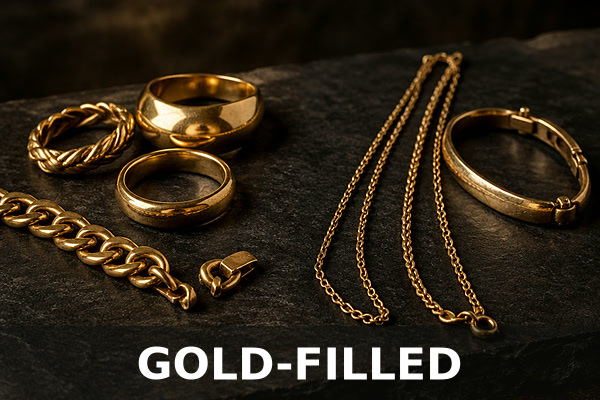
Gold-Filled or Solid? What Jewelry Stamps Mean With Gold Near $4,160
With gold near about $4,160 an ounce on our live ticker, a jewelry drawer full of yellow metal suddenly looks like money. The trap is that not every yellow piece is solid karat gold. Some are gold-filled, gold overlay, or thin plate that only looks the part.
Here is how those stamps differ, why melt offers diverge, and what Local Coin Company can do when you bring a mixed lot in. This is educational information, not financial, jewelry appraisal or legal advice.
Solid karat vs gold-filled: the FTC yardstick
Solid karat jewelry is a gold alloy all the way through (it can still be hollow in shape, but the metal itself is karat gold). The karat mark tells you how many parts out of 24 are pure gold. Eighteen-karat is 18 parts gold (75%). Fourteen-karat is 14 parts gold (about 58%). Ten-karat is 10 parts gold (about 42%).
The Federal Trade Commission's consumer jewelry guidance draws a bright line for layered pieces. "Gold filled," "gold overlay," and "rolled gold plate (RGP)" mean a layer of at least 10-karat gold was mechanically bonded to a base metal such as brass or nickel. Those pieces should carry both the karat of the gold layer and a construction term or abbreviation. A common mark is something like "1/20 14K GF": the outer layer is 14-karat gold, and that layer is about one-twentieth (5%) of the metal weight of the item. If the gold layer is thinner than one-twentieth, the fraction should be stated (for example, "1/40 14K gold overlay").
Gold electroplate, gold flashed and gold washed are thinner still. Vermeil is gold over sterling silver. Color alone cannot separate these categories. A worn gold-filled chain can look dull at the clasp while a clean 10K ring still looks bright.
Why melt math diverges so fast
Scrap buyers price recoverable gold. On a solid 14K ring, roughly 58% of the metal weight is gold (before stones, springs and solder are set aside). On a true gold-filled piece marked 1/20 14K GF, only about 5% of the metal weight is that 14K layer — and that layer itself is only about 58% pure gold. The recoverable fine gold is a small fraction of what a same-weight solid karat piece holds.
APMEX's gold-filled selling guide puts the contrast plainly: gold-filled can sometimes be sold, but it is very different from selling solid gold. Many local cash-for-gold counters will not bother with small gold-filled lots because refining cost eats the tiny recoverable metal. When gold-filled is accepted, buyers often want bulk (bags of watchbands, eyeglass frames, mixed GF scrap). APMEX's own Old Gold Program accepts solid karat jewelry and related scrap categories, but not gold-filled products.
With spot gold near about $4,160, that gap is easy to feel in dollars. Two chains that look alike in a photo can be worlds apart at the scale. That is why a per-piece "cash for gold" guess without sorting is a bad plan.
How to sort a drawer before you sell
Start with the stamps under good light. Marks such as 10K, 14K, 18K, 417, 585 or 750 point toward solid karat claims. Marks with GF, G.F., gold filled, gold overlay, RGP, HGE, GP, GEP or a fraction-plus-karat string point toward layered construction. Unmarked pieces are common on older or handmade lots — treat them as "test required," not as automatic junk.
Separate solid-looking karat jewelry from anything stamped filled, overlay, plate or flashed. Keep costume "gold tone" pieces in a third pile. Do not acid-test at home if you can avoid it; a botched test scars metal and does not replace a shop test. Leave stones in place unless we ask otherwise. Our guide to gold hallmarks and our jewelry versus bullion comparison cover related stamp language. For how scrap buyers think about mixed lots, see scrap gold versus bullion.
What we buy, and how offers get made
Local Coin Company buys gold, silver, platinum, palladium, jewelry, diamonds, coin collections, sterling silverware and dental gold for cash. Solid karat jewelry belongs in that buy list. Gold-filled and plated pieces are a different conversation: small lots may have little melt value, while a large sorted GF bag can still be worth a look. Bring the drawer sorted if you can. We will weigh, test and explain what is driving the number.
Buy spreads on irregular jewelry scrap are often wider than on recognized one-ounce bullion. Testing and refining cost more per dollar on tiny or layered pieces. Our plain-English guide to how coin shops price buybacks covers the categories. Soft-touch prices on the homepage are a snapshot; the counter quote uses today's tested content. If you are comparing sterling flatware in the same estate box, our sterling versus silver plate post is the silver cousin of this gold-filled question.
Our take (opinion): sort first, then decide
In our view, the biggest money left on the table is not a few points of buy spread — it is dumping a mixed drawer as one "gold jewelry" lot. Solid karat belongs in one bag. Gold-filled and plate belong in another. Dental scrap and silverware belong in their own piles (see our dental gold guide). We think sellers should get a tested, itemized read before they accept a flat cash figure. Sentiment can stay at home. Pricing should stay on metal.
Bringing jewelry to Tualatin
Bring pieces sorted, skip polishing, and leave clasps and stones alone. Our coin shop visit checklist covers the basics. For storage after you buy metal, see our home storage guide. Current bullion snapshots live on our gold page. We are at 19354 SW Boones Ferry Rd., Tualatin, OR 97062. Normal trading hours are Monday through Friday 8 AM to 4 PM and Saturday 8 AM to 3 PM. Appointments have priority, so call 503-855-5255 to schedule.
Sources: Federal Trade Commission, "Buying Platinum, Gold, and Silver Jewelry" (consumer.ftc.gov); APMEX, "Can You Sell Gold-Filled Jewelry?" (February 4, 2026); APMEX scrap gold calculator notes on GF vs solid karat; Kitco News (October 13, 2026); localcoinco.com prices as of October 13, 2026.
RETURN <<