 Local Coin Company
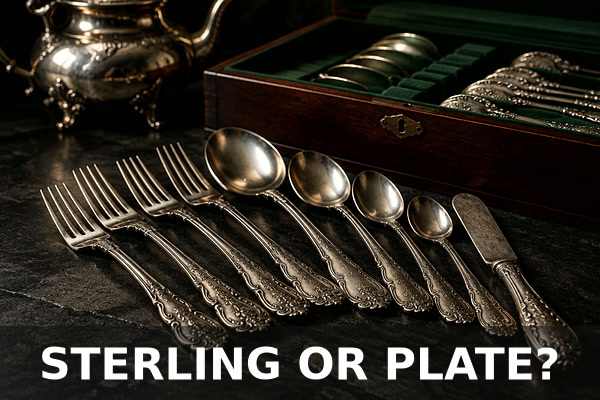
Sterling or Silver Plate? What That Old Silverware Set Is Worth With Silver Near $61
It is a familiar find in family estates around the Portland metro: a wooden chest of forks and spoons that came out for holidays and then sat in a closet for decades. Sometimes it is solid sterling. Sometimes it is silver plate that looks just as shiny. With silver near about $61 an ounce on our site's ticker after Friday's gain, the difference between the two can be worth thousands of dollars or close to nothing.
Here is how to tell what you have, the marks that matter, the heavy pieces that fool people, and how to estimate melt value at the kitchen table before you visit a shop in Tualatin or anywhere around Portland. This is educational information, not financial advice.
What "sterling" actually means
Sterling is an alloy, not pure silver. Federal Trade Commission jewelry guides say a product should not be called "sterling," "sterling silver" or "Ster." unless it is at least 925 parts per thousand pure silver, in other words 92.5%. The rest is usually copper, which makes the metal hard enough for everyday use, as refiner Phoenix Refining explains.
The same FTC guide covers an older American term: "coin" or "coin silver" should be at least 900 parts per thousand silver. If you see "COIN" stamped on an old spoon, it is still a solid silver piece, just at a slightly lower fineness than sterling.
Silver plate is a different thing entirely. It is a base-metal object with a thin coating of silver on the surface. The National Gold and Silver Stamping Act, the 1906 federal law that still governs these marks, says silver-plated articles may not be stamped with the word "sterling" or the word "coin," either alone or with other words.
Read the marks before anything else
Turn a fork or spoon over and look at the back of the handle with good light, or a magnifier if you have one. What you are hoping to see:
- American sterling: the word "STERLING," the abbreviation "STER." or the number "925," often with a maker's name or trademark nearby.
- Older American silver: "COIN" (at least 900 fine, per the FTC guide).
- British sterling: a small walking lion, called the lion passant. Under the UK Hallmarking Act, it is the traditional mark for 925 silver; Scotland's Edinburgh assay office uses a rearing lion rampant instead. The Silver Society notes the lion passant dates to 1544, under Henry VIII, and after 1720 it was used by every English assay office.
Marks that usually mean plate rather than solid silver include "EPNS," which the Silver Society says stands for electroplated nickel silver, and wording such as "silver plate." The Silver Society also warns that some plate makers struck marks in little shields designed to look like British hallmarks. Old "Sheffield plate," invented around 1743, was made by fusing a sheet of sterling to a copper core, so it is not solid silver either.
One caution about home acid kits: the Silver Society points out that a test fluid only checks the surface layer, so plated pieces can test as silver. A mark plus a proper test is the safer combination.
The heavy pieces that fool people
The biggest surprise for sellers is usually candlesticks. Many are marked "Sterling Weighted," "Weighted," "Cement Filled" or "Reinforced." According to Phoenix Refining, these are genuine sterling on the outside, but the shell is thin and the inside is filled with cement, pitch, plaster, wax, resin or steel rods. In many common weighted pieces, the refiner says, the sterling shell is only about 10% to 20% of the total weight. A 500-gram candlestick, by its example, may hold just 50 to 100 grams of sterling.
Knives are the other trap. Precious metals refiner Elemetal notes that many sterling knives, like candlesticks, are weighted with non-precious materials. So when you weigh a set, set the knives aside and count only the solid forks, spoons and serving pieces at full weight.
A magnet is a quick first check, but not the final word. Phoenix Refining says a magnet may pick up steel reinforcement inside genuine weighted sterling, so a magnetic tug does not automatically mean a piece is plated.
Do the melt math at your kitchen table
Melt value is just pure silver content times the spot price. A troy ounce is 31.1035 grams, and sterling is 92.5% silver. With our ticker showing silver near about $61 an ounce:
- Each troy ounce of solid sterling holds about $56 of silver.
- Each gram of solid sterling works out to roughly $1.80 in metal.
As a purely hypothetical example: if your solid forks, spoons and serving pieces weigh 2,000 grams on a kitchen scale, that is about 59.5 troy ounces of pure silver, or roughly $3,600 in melt value at today's price. Weighted knives or candlesticks would add only a fraction of their scale weight.
Melt value is not a shop's buy price. Any dealer has to leave room for handling, refining and price risk. Our guide on how coin shops price buybacks explains that gap in plain English. For comparison, our silver page on October 10 listed a 1 oz Silver Eagle at around $66 to buy from us and around $59 when we buy one back.
Our take (opinion): slow down before you scrap it
In our view, three habits save sellers money:
- Don't polish first. A shine does not add silver. Our post on why silver tarnishes covers when cleaning helps and when it does not.
- Don't break open candlesticks or knives yourself. Bring them whole and let the weighting be assessed.
- Ask before assuming melt. A complete set in a well-known pattern, or a piece by a notable maker, may interest a collector. Melt is the floor, not always the ceiling.
If the silverware came from a parent or grandparent along with coins or jewelry, our guide to inherited estate coins walks through sorting everything before you sell, and our coin shop visit checklist covers what to bring.
Bring it by in Tualatin
Local Coin Company buys sterling silverware along with gold, silver, jewelry and coin collections. We are at 19354 SW Boones Ferry Rd., Tualatin, OR 97062. Our normal trading hours are Monday through Friday 8 AM to 4 PM and Saturday 8 AM to 3 PM. Appointments have priority, so call 503-855-5255 to schedule.
Sources: Federal Trade Commission Guides for the Jewelry, Precious Metals, and Pewter Industries, 16 CFR 23.5; National Gold and Silver Stamping Act, 15 U.S.C. 294 and 297; UK Hallmarking Act 1973, Schedule 2; The Silver Society, "Identify Your Silver"; Phoenix Refining, weighted sterling silver; Elemetal, sterling flatware and holloware recycling guide; localcoinco.com prices as of October 10, 2026.
RETURN <<