 Local Coin Company
Morgan and Peace Silver Dollars: The 1918 Meltdown and What Yours Holds Today
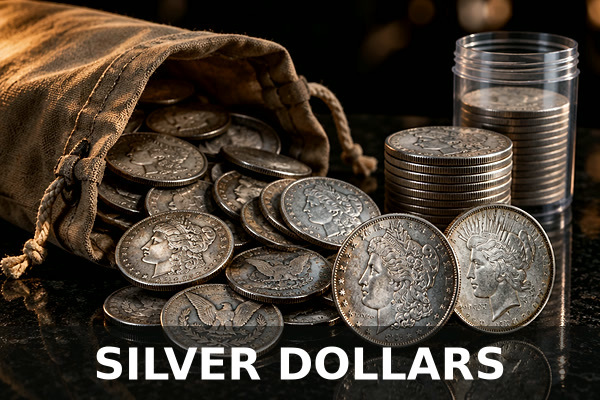
Of all the coins that turn up in estate boxes and dresser drawers around Tualatin and the Portland metro, few get a bigger reaction than the old silver dollar. It is heavy, it is big, and it usually carries a date from 1878 to 1935. Most of these are Morgan or Peace dollars, and the story of how they survived is better than most people expect: in 1918, the U.S. government melted more than 270 million of them.
Here is where these coins came from, how to read the one in your hand, and what it holds with silver near about $61 an ounce on our site's ticker. This is educational information, not financial advice.
Born from a fight over silver
The Morgan dollar exists because of a political fight. The U.S. Mint's timeline records that the Bland-Allison Act of February 28, 1878 authorized the coinage of the silver dollar again, and the Mint notes that the law brought back the standard silver dollar at 26.73 grams, 90% silver and 10% copper. The coin took its name from its designer, George T. Morgan, with a profile of Lady Liberty on the front and a heraldic eagle on the back.
According to the Mint, the first Morgans were struck at Philadelphia in 1878, then at San Francisco and Carson City, close to the western silver mines. New Orleans joined in 1879. Production ran through 1904, and no silver dollars at all were minted from 1905 to 1920.
The great meltdown of 1918
During World War I, Britain needed silver. The Pittman Act, approved April 23, 1918, authorized the Treasury to melt up to 350 million standard silver dollars and sell the metal as bullion at no less than $1 an ounce, partly to assist governments at war with the enemies of the United States. PCGS reports that 270,232,722 silver dollars were melted, with the silver shipped to Calcutta and re-coined into Indian rupees.
The same law had a catch that shaped what collectors find today. It required the Mint to buy an equal amount of American-mined silver at a fixed $1 an ounce and coin it back into silver dollars. That is why the Morgan returned in 1921, struck at Philadelphia, San Francisco and, for the first time, Denver.
The Peace dollar, and the coin that never was
Late in 1921, the design changed. The Mint says Treasury Secretary Andrew Mellon approved the Peace dollar in December 1921 to mark the declaration of peace between the United States and Germany. Its designer, Anthony de Francisci, gave Liberty a tiara of light rays and put an eagle perched on a mountaintop, holding an olive branch, on the reverse. It kept the same 26.73-gram, 90% silver standard.
PCGS notes that the 1921 coins, and a few dated 1922, were struck in high relief before the design was flattened to strike better. Peace dollars were made from 1921 through 1928 and again in 1934 and 1935. Then comes our favorite footnote: in 1964 the Denver Mint struck 316,076 Peace dollars, and PCGS says all of them were destroyed before release. The Mint confirms none reached the public.
One more twist: the 1970 law that created the Eisenhower dollar also authorized the sale of 2.8 million Carson City Morgan dollars that had sat in Treasury vaults. Collectors call these the GSA hoard coins, and PCGS tracks them with separate listings.
How to read the one you have
- Which design: a Liberty profile with an eagle and wreath is a Morgan (1878-1904, 1921). Liberty with a rayed crown and the word PEACE on the back is a Peace dollar (1921-1935).
- Mint mark: PCGS says Morgan mint marks sit on the reverse just beneath the ribbon bow of the wreath: CC for Carson City, O for New Orleans, S for San Francisco, D for Denver (1921 only). No mark means Philadelphia. Peace dollars come from Philadelphia, Denver and San Francisco.
- Size check: PCGS lists the original coins at 26.73 grams and 38.10 millimeters. A coin that is clearly off on weight deserves a closer look; see our counterfeit red flags post.
- Modern versions: the 1921 Silver Dollar Coin Anniversary Act brought both designs back in 2021. The Mint struck those in .999 silver, and its 2021 Morgans with CC and O privy marks were made at Philadelphia, not in Carson City or New Orleans.
What one holds at today's price
The Pittman Act itself spells out the silver in a standard dollar: 371.25 grains of pure silver, which works out to about 0.773 troy ounces. With our ticker showing silver near about $61:
- Morgan or Peace dollar (1878-1935): roughly $47 of silver per coin, in line with NGC's melt calculator. A 20-coin roll holds about $940 in melt.
- 2021 Morgan or Peace (.999 silver): about 0.859 troy ounces, or roughly $52 in silver.
Melt is only the starting point. PCGS calls the 1889-CC and 1893-S key dates in the Morgan series and the 1928 Philadelphia issue the key Peace dollar, and it notes that some dates are common in low grade but rare in top condition. In our view, that is why silver dollars should never be priced like a bag of dimes. Our guide on how coin shops price buybacks explains how dealers think about the gap between melt and a buy price.
Our take (opinion): keep dollars in their own pile
In our view, the biggest mistake families make is tossing silver dollars into the same coffee can as 90% dimes and quarters. Our junk silver guide covers that category, but dollars deserve a separate sort by design, date and mint mark. A few more suggestions:
- Don't clean or polish them. Toning is normal, and our post on why silver tarnishes explains why scrubbing can cost you.
- Keep original holders, mint packaging and any paperwork together with the coins.
- Learn the difference between bullion value and collector value with our numismatic or bullion explainer, and if the coins came from a parent's estate, start with our guide to inherited estate coins.
Bring your silver dollars to Tualatin
Local Coin Company buys coin collections along with gold, silver and jewelry, and we stock U.S. coinage. Current silver prices are on our silver page. We are at 19354 SW Boones Ferry Rd., Tualatin, OR 97062. Our normal trading hours are Monday through Friday 8 AM to 4 PM and Saturday 8 AM to 3 PM. Appointments have priority, so call 503-855-5255 to schedule.
Sources: U.S. Mint, "One Hundred Years of Silver Dollar Coinage (1878-1978)," historical timeline, and May 7, 2021 Morgan and Peace dollar release; Pittman Act, 40 Stat. 535 (1918), via FRASER, St. Louis Fed; Public Law 116-286, 1921 Silver Dollar Coin Anniversary Act; PCGS CoinFacts, Morgan and Peace dollar series pages; PCGS, "How Morgan Dollars Became Indian Rupees"; NGC Peace dollar melt value page; localcoinco.com prices as of October 11, 2026.
RETURN <<