 Local Coin Company
What Is Junk Silver? 90 Percent U.S. Coins Explained
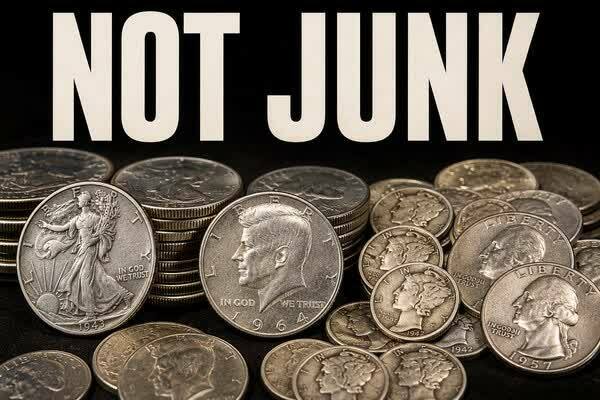
That jar of old dimes, quarters, and half dollars is not pocket change. If the dates are 1964 or earlier, those coins were struck in 90 percent silver. Dealers call the common, circulated pieces "junk silver"a trade name for metal content, not a comment on quality.
This guide explains what junk silver is, why the Coinage Act of 1965 changed U.S. circulating coinage, how shops price 90 percent by face value, and how buyers in Tualatin and the Portland metro can compare it with modern silver coins and bars. It is educational, not a forecast of the next move in silver.
What "Junk Silver" Actually Means
In the bullion aisle, junk silver usually means circulated United States dimes, quarters, and half dollars dated 1964 and earlier. Typical designs include Mercury and Roosevelt dimes, Washington quarters, and Walking Liberty, Franklin, and 1964 Kennedy halves. They are legal-tender U.S. coins whose market value is driven by silver, not by rare dates or high grades.
"Junk" means the coins are common enough that they trade near melt instead of as collectibles. Rare mintmarks and most Morgan or Peace dollars are priced as numismatic coins, not as a junk-silver bag. Local Coin Company's silver page lists a 1000-dollar face 90 percent silver bag when that product is in stock, alongside 1 oz Eagles, Maples, rounds, and 10 oz or 100 oz bars. Cents were never 90 percent silver, and most nickels were not either.
The 1965 Change, in Plain Language
Congress passed the Coinage Act of 1965 (Public Law 89-81, July 23, 1965) to take most silver out of everyday money. The statute authorized clad dimes and quarters with copper-nickel outer layers bonded to a copper core, and it set a silver-clad half dollar at 11.5 grams total weight containing 4.6 grams of silver40 percent silver by weight.
The same law allowed dimes, quarters, and halves to be minted from 900 fine coin silver only until the Treasury had enough of the new clad coins, and in any event no later than five years after enactment. It also required that any 900 fine coins minted after the Act be dated 1964. That is why a 1964 dime, quarter, or half is the last circulating 90 percent issue most people will see.
A later coinage law, described by the United States Mint in its 1970 coinage-law summary, removed remaining silver from the circulating half dollar. Circulating Kennedy halves from 1971 onward are copper-nickel clad, matching today's dimes and quarters under 31 U.S.C. 5112. Halves dated 1965 through 1970 remain the 40 percent silver-clad type. Price them separately from a 90 percent bag.
How Dealers Price 90 percent Silver
Spot is the wholesale reference for the metal. What you pay is spot plus a premium; what you receive when selling is typically below that same reference. Premiums move with demand and inventory, so treat any posted number as a snapshot.
Shops price circulated 90 percent by face value, not by weighing every dime. Ten dimes, four quarters, or two halves are all 1 dollars of face. The market convention for worn coins is about 0.715 troy ounces of silver per 1 dollars of face, a little under original mint weight to allow for wear. A 1000-dollar face bag is therefore about 715 troy ounces of silver before you apply today's spot and the dealer's buy or sell spread. Smaller 10 dollars, 50 dollars, or 100 dollars face lots are common starter sizes. For how offers relate to spot, see how to sell gold and silver in Tualatin.
Junk Silver vs. Silver Eagles and Bars
Modern bullion solves a different problem. Under 31 U.S.C. 5112(e), American Eagle silver bullion coins weigh 31.103 grams, contain .999 fine silver, measure 40.6 millimeters across, and carry a 1 dollars face value with a government guarantee of weight and purity. They are easy to recognize and usually carry a higher premium per ounce than circulated 90 percent.
Barsespecially 10 oz and 100 oz pieces from known refinersare built to pack more ounces into the dollars you spend. For the full coins-versus-bars trade-off, see silver coins vs silver bars. Junk silver sits between those products: government-issued U.S. coins, small divisible units, and often a lower premium per ounce than 1 oz Eagles. It is bulkier than gold for the same dollars, so storage planning matters sooner.
How to Spot 90 percent in a Drawer
Start with the date. Dimes and quarters dated 1964 or earlier are the 90 percent type. Halves dated 1964 are 90 percent; 19651970 halves are 40 percent silver clad; later circulating halves are copper-nickel clad. Then look at the edge: 90 percent coins are silver-colored through the reeds, while clad coins show a copper sandwich stripe. That check is a screen, not a lab assay. A shop can sort a mixed pile before quoting. Do not acid-test or scratch collectible pieces.
Buying or Selling 90 percent in Tualatin
Local Coin Company is at 19354 SW Boones Ferry Rd., Tualatin, OR 97062. Hours are MondayFriday 8 AM4 PM and Saturday 8 AM3 PM. Call 503-855-5255 to plan a visit. Appointments have priority.
Ask to compare today's 90 percent bid and ask with live Eagle, round, and bar quotes on the silver and gold pages. If you are taking metal home, have a storage plan before you leave; see our guide on storing gold and silver safely at home.
FAQ
Is junk silver the same as constitutional silver?
People use both names for pre-1965 90 percent U.S. dimes, quarters, and halves. In the shop, "90 percent" or "junk" is the clearer term.
Are 19651970 Kennedy halves junk silver?
No. Those circulating halves are the 40 percent silver-clad type from the 1965 law, not 90 percent.
Is a 1000-dollar bag a good first buy?
Only if you want that much silver in one position and can store it. Many first-time buyers start with a smaller face-value lot.
Do the coins still spend as a dime or a quarter?
Yes. They remain U.S. legal tender. Their silver value is far above face, which is why nobody spends a 1964 quarter at the grocery store.
Bottom Line
Junk silver is common pre-1965 90 percent U.S. coinage priced as metal. The Coinage Act of 1965 ended that alloy in circulating dimes and quarters, left a 40 percent half for a few more years, and is why the date on the coin still matters. 90 percent is divisible and recognizable; Eagles cost more per ounce for liquidity, and bars can deliver more ounces per dollar. Sort 90 percent from 40 percent and clad, confirm today's quote, and buy metal you can store and later sell with confidence.
When you are ready to compare options in person, check current silver and gold offerings, or stop by the Tualatin shop.
Related reading: troy ounce explained.
Educational disclaimer: This article is for general information only and is not financial, legal, tax, or investment advice. Precious metals involve risk, including price volatility and changing premiums. Product availability and pricing change; confirm current quotes with Local Coin Company and qualified advisors before you buy or sell.
RETURN <<