 Local Coin Company
Sovereigns and 20 Francs: The Old European Gold Coins Tualatin Families Inherit
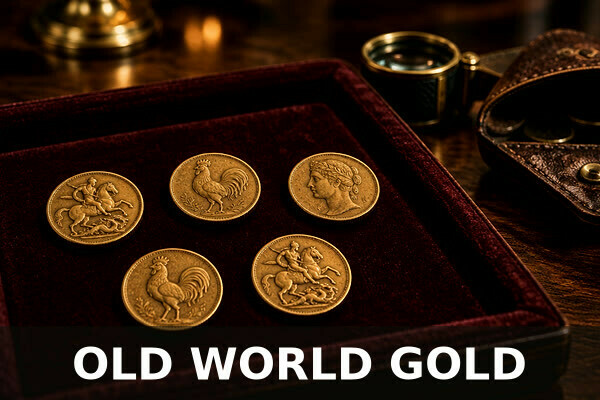
Not every gold coin in a family collection is American. Open an old coin box from a grandparent who traveled or simply liked gold, and you may find small foreign pieces: a coin with a horseman fighting a dragon, or one with a rooster or a woman's profile. Our gold page lists two of them by name, British Sovereigns and European 20 Francs, near the bottom of the list, after the Eagles, Maple Leafs and bars.
With gold near about $4,206 an ounce on our site's ticker after Friday's bounce, these little coins carry real money. Here is what they are, how to identify them and how to think about their value, whether you are in Tualatin, Lake Oswego or anywhere in the Portland metro. Educational only, not investment advice.
The British Sovereign: a one-pound coin with a long history
The sovereign goes back to 1489, when Henry VII ordered a large gold coin worth 20 shillings, according to the Royal Mint. The version you are likely to see is the modern sovereign, revived under George III. The Royal Mint Museum says it became currency under a proclamation on July 1, 1817, as a 20-shilling piece worth one pound, replacing the 21-shilling guinea.
Its reverse is the famous design by the Italian engraver Benedetto Pistrucci showing St George on horseback slaying the dragon. The Royal Mint says that design was replaced in 1825 and brought back in 1871, and it still appears on sovereigns today. Because of its accuracy and reliability, the Royal Mint says the sovereign became known as "the chief coin of the world."
The key numbers, from the Royal Mint:
- Weight: 7.98 grams of 22-carat gold (916.67 fine).
- Diameter: 22.05 mm.
- Pure gold: 0.2354 troy ounce, or about 7.32 grams.
The Royal Mint Museum notes that today's sovereign has the same specifications introduced in 1817, regulated by law to five decimal places, and still carries a nominal value of one pound. That consistency is the whole appeal: a sovereign from 1890 and one struck this year hold the same amount of gold.
Sovereigns from Australia, Canada, India and South Africa
Many sovereigns were never struck in London at all. The Royal Mint ran branch mints across the British Empire between 1855 and 1932, close to where gold was mined. Look on the reverse for a small mint mark letter. On Ottawa coins, for example, the Royal Mint says it sits in the ground above the date. The marks to know:
- S for Sydney, M for Melbourne and P for Perth in Australia.
- C for Ottawa, Canada, which struck fewer than one million sovereigns from 1908 to 1919.
- I for Bombay (now Mumbai), India, open for about one year, striking more than a million sovereigns in 1918.
- SA for Pretoria, South Africa, which struck more than 18 million sovereigns in 1928 alone and issued them until 1932.
The Royal Mint says branch-mint sovereigns were identical in weight and fineness to London coins, so bullion value is the same. Some dates and mint marks carry collector premiums, which is why it pays to have a dealer look before you treat every sovereign as melt.
One more detail: color. The Royal Mint says early Sydney sovereigns looked more yellow than London coins because their alloy included silver, and the Royal Mint's own 2026 bullion sovereign returned to a yellow alloy after recent rose-toned issues. A sovereign that looks redder or yellower than another is not automatically suspect.
The 20-franc piece: one standard, many countries
The other coin on our list traces back to Napoleon. In 1803 France defined its franc in silver, and the 20-franc gold piece was set at 6.45 grams of 0.900 fine gold, according to Latin Monetary Union coin reference lmucoins.com. In 1865 France and its neighbors Belgium, Italy and Switzerland formalized that standard as the Latin Monetary Union. The union's 1885 monetary convention, reprinted by the World Gold Council, fixed the 20-franc piece at 6.45161 grams, 900 fine and 21 mm across. The World Gold Council notes the system was suspended during World War I and ceased to function in 1926.
Because several countries struck coins to that standard, a "20 francs" coin might be French, Swiss, Belgian or Italian (where it was 20 lire). Common types include the French Rooster, struck from 1898 to 1914, and the Swiss "Vreneli," struck from 1897 to 1947, per lmucoins.com. Collectors often call any of them a "Marengo," after an early 20-franc coin minted to mark Napoleon's victory at the Battle of Marengo.
The math on gold content: 6.45161 grams times 0.900 equals about 5.81 grams of pure gold, or roughly 0.1867 troy ounce.
How they compare with U.S. fractional gold
A sovereign holds about 94% of the gold in a quarter-ounce American Gold Eagle. A 20-franc piece holds a bit less than two tenth-ounce Eagles' worth of gold. Our guide to fractional gold coins covers why smaller sizes can make sense for some buyers.
The difference is that a modern Eagle's value is mostly metal plus a bullion premium, while an old sovereign or 20-franc coin can be bullion, a collectible or a bit of both, depending on date, mint and condition.
What they are worth in metal right now
Melt value is simply gold content times the spot price. Using about $4,206 an ounce from our ticker:
- A sovereign's 0.2354 ounce of gold works out to about $990 in metal.
- A 20-franc coin's roughly 0.1867 ounce works out to about $785.
Melt value is not a dealer's buy price, which must leave room for handling and resale. On our gold page as of October 10, our listed buy price was around $906 for a British Sovereign and around $718 for European 20 Francs, with sell prices marked "Call." For comparison, a quarter-ounce Gold Eagle was listed for sale around $1,190 and a tenth-ounce Eagle around $540.
Watch for fakes and for hidden value
The Royal Mint says the sovereign has long attracted counterfeiters, some using base metal and others using real gold in misleading copies. Its 2026 bullion sovereign adds micro-text and a latent image to fight that. Weight and diameter are the first checks: about 7.98 grams and 22.05 mm for a sovereign, and about 6.45 grams and 21 mm for a 20-franc piece. Our guide to counterfeit red flags covers more warning signs.
Our take (opinion): If you inherited a handful of these, do not clean them, and do not assume they are all worth only melt. Sort them by country and date, then have them looked at in person. Our post on inherited estate coins walks through that process.
Bring them by in Tualatin
Local Coin Company is at 19354 SW Boones Ferry Rd., Tualatin, OR 97062. We are open Monday through Friday 8 AM to 4 PM and Saturday 8 AM to 3 PM. Appointments have priority, so call 503-855-5255 to schedule.
Sources: The Royal Mint (sovereign history, reverse designs, 1817 sovereign, 2026 bullion sovereign specifications and security features, branch mint history); Royal Mint Museum; World Gold Council, "Key documents in the history of gold," 1885 Latin Monetary Union convention; lmucoins.com Latin Monetary Union coin lists; localcoinco.com prices as of October 10, 2026.
RETURN <<