 Local Coin Company
Did Gold Rise, or Did the Dollar Fall? Reading Friday's Rebound for Tualatin Buyers
Gold had a rough start to the week and a strong finish. After dipping to around $4,100 an ounce on Wednesday, its lowest level since early August, spot gold climbed back toward $4,200 on Friday, October 9. On our site's live ticker Friday afternoon, gold showed near about $4,206, up roughly $70 on the day, and silver near about $61, up nearly $2.
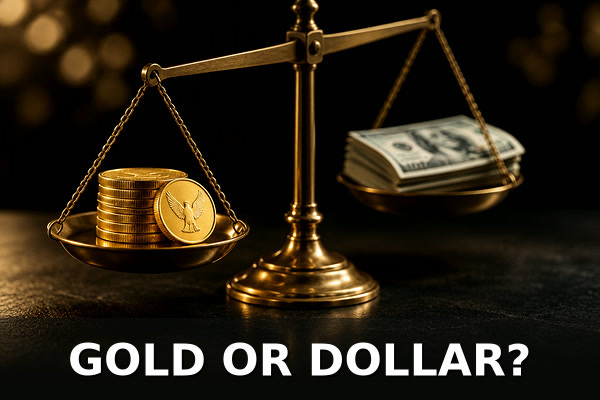
Headlines say "gold rallied." But a gold price is really a ratio: dollars per ounce. When it changes, either gold got more valuable, the dollar got less valuable, or both. Here is how to tell the difference, using Friday as the example. Educational only, not investment advice.
What moved on Friday
Kitco's morning report put the rebound down to three things moving at once: a softer U.S. dollar, easing Treasury yields and a pullback in oil. Oil fell after President Trump said Thursday that the U.S. would not attack Iran before the November 3 midterm elections and that talks were productive, according to Yahoo Finance and Kitco. Kitco said that took some of the strike premium out of crude, which had pushed Brent above $104 a barrel; by Friday morning Brent was near $102.58.
Lower oil means less fuel for inflation worries, and that eased pressure on yields. Kitco had the 10-year Treasury yield near 5.25% after a strong 30-year bond auction on Thursday. Market pricing for another Federal Reserve rate hike in October slipped to roughly 17% to 19%, though odds of a December hike stayed near 82% to 83%, according to the same report.
Then came a mixed signal. The University of Michigan's preliminary October consumer sentiment index fell to 46.3, below September's 48.1 and below the 47.6 economists expected, Kitco reported. Year-ahead inflation expectations ticked up to 4.7% from 4.6%, and long-run expectations rose to 3.5% from 3.4%. The survey's director, Joanne Hsu, wrote that "frustration over cost-of-living continues to mount." Gold held near the top of its daily range after the release.
Why the dollar matters to every gold price
Gold trades worldwide, but the benchmark price is quoted in U.S. dollars. So when the dollar strengthens against other currencies, an ounce of gold costs more for a buyer in Europe or Japan even if the dollar price does not change. Adam Turnquist, chief cross-asset strategist at LPL Financial, put it simply in a note quoted by Kitco: "A stronger dollar makes gold more expensive for foreign buyers," and "gold has historically struggled during periods of dollar strength."
That is part of why gold has struggled this fall. Turnquist said the U.S. Dollar Index had broken out above a double-bottom chart pattern and past its June highs near 101.75. That index tracks the dollar against a basket of six currencies, with the euro making up 57.6% of the weight, followed by the Japanese yen, British pound, Canadian dollar, Swedish krona and Swiss franc. When that dollar rally paused on Friday, gold got some breathing room.
A simple tool: split the move in two
You do not have to guess how much of a move came from the dollar. Kitco publishes a free tool called the Kitco Global Index that breaks each day's change in gold and silver into two parts: the part caused by the dollar strengthening or weakening, and the part caused by normal trading, meaning actual buying and selling of the metal. Kitco says its dollar calculation follows the same method as the U.S. Dollar Index.
Kitco describes four basic scenarios, which boil down to this:
- Index up, dollar price up even more: gold gained real value, and a weaker dollar exaggerated the gain.
- Index down, dollar price down even more: gold lost value, but less than the dollar price makes it look.
- Index up, dollar price down: gold gained value against other currencies, but a stronger dollar hid it.
- Index down, dollar price up: the "rally" was mostly a weaker dollar, not new demand for gold.
Next time gold jumps $70 in a day, check that split. It shows whether buyers were chasing metal or the currency simply slipped.
Why this matters if you buy physical gold in Tualatin
Our take (opinion): A move driven mostly by the dollar can reverse just as fast when the dollar turns, and Friday's move leaned heavily on one headline about oil and Iran. That does not make it a bad day to buy, and it does not make it a good one either. It means a single green day is not a trend.
For a coin or bar you plan to hold for years, the dollar-versus-demand question is context, not a timing signal. Buyers should compare premiums and the buy/sell spread, not just spot. Sellers should know the price we pay moves with spot all day. Our guide to how coin shops price buybacks explains how that works, and our earlier post on reading oil, yields and the dollar together covers the same chain from the other direction, when oil rose and gold fell.
Silver rose more than gold in percentage terms, partly because, as Kitco noted, lower oil also helped silver's risk-sensitive industrial side. Bigger bounces come with bigger swings.
What to watch next week
Analysts quoted by Kitco were split. Lukman Otunuga of FXTM said Wednesday's CPI report "could give bears fresh confidence if inflation proves sticky amid higher energy prices." Ole Hansen of Saxo Bank expects gold to stay range-bound but called the recovery from below $4,100 "encouraging." The calendar:
- Monday, October 12: Columbus Day. U.S. banks are closed, though U.S. stock markets are open, per Kitco.
- Wednesday, October 14: September Consumer Price Index at 8:30 a.m. Eastern (5:30 a.m. Pacific), according to the Bureau of Labor Statistics schedule.
- Thursday, October 15: Producer prices, retail sales and weekly jobless claims, plus Fed Chair Kevin Warsh at the IMF and World Bank meetings late that evening Eastern time.
A hot CPI could firm the dollar and yields again; a soft one could do the opposite. For more on how the Fed shapes gold, see our post on gold and the Fed minutes.
What it looks like at our counter
Prices change with spot, so check our gold page and silver page for current numbers. As a rough guide on the afternoon of October 9, with gold near about $4,206 an ounce:
- A 1 oz American Gold Eagle was around $4,390, and a 1 oz Gold Krugerrand was around $4,300.
- A tenth-ounce American Gold Eagle was around $540.
- A 1 oz Silver Eagle was around $66, and a generic 1 oz silver round was around $63.50.
Both pages list what we sell for and what we pay, so you can see the spread before you decide.
Talk it through in person
Want a second opinion on a week like this, or a quote on coins you own? Stop by Local Coin Company at 19354 SW Boones Ferry Rd., Tualatin, OR 97062, Monday through Friday 8 AM to 4 PM or Saturday 8 AM to 3 PM. Appointments have priority, so call 503-855-5255 to schedule.
Sources: Kitco News, October 9, 2026 (Kitco AM report; consumer sentiment report; weekly gold outlook); Kitco Global Index page; University of Michigan Surveys of Consumers, preliminary October 2026 results; Yahoo Finance, October 9, 2026; Bureau of Labor Statistics release schedule; localcoinco.com prices as of October 9, 2026.
RETURN <<