 Local Coin Company
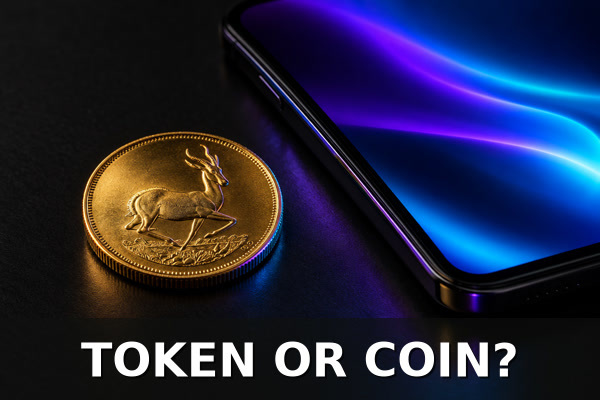
Tokenized Gold vs. a Coin in Your Hand: What Tualatin Buyers Should Know
Gold has always been the asset you can hold in your hand. Now some of the biggest names in the bullion business want you to hold it on your phone, too. At the London Bullion Market Association's (LBMA) annual Global Precious Metals Conference in early October, a panel of bankers and industry leaders made the case for "tokenized" gold, a digital record of ownership in metal sitting in a vault.
If you buy gold in Tualatin or around the Portland metro, expect to hear more about "digital gold." Here is what it is, why the industry is excited, and what to ask before you trade a coin for a code. Educational only, not investment advice.
What a gold token actually is
A gold token is a digital unit, recorded on a blockchain or similar shared ledger, that represents a claim on physical gold held by a custodian. You do not hold the metal. You hold a record saying some of it is yours, or is owed to you.
A bank example is the HSBC Gold Token in Hong Kong, which HSBC called the first tokenized real-world asset issued by a bank for retail investors when it launched in March 2024. According to HSBC, it is "a digital token on our distributed ledger, backed by physical gold bars kept in our vault," and each token represents 0.001 troy ounce of gold. HSBC also states plainly: "Please note investors cannot take delivery of the underlying gold."
For scale, U.S. law sets the $5 American Gold Eagle at one-tenth troy ounce of fine gold. That one small coin holds the same amount of gold as 100 of those tokens.
Why the big banks are excited: the "dead asset" problem
Kitco News reported from the LBMA conference that Vincent Domien, head of precious metals trading at ICBC Standard Bank, described gold on an institution's books as a "dead asset" that is "doing absolutely nothing for you." He said institutional demand for tokenized gold remains relatively low, but could change if tokens make gold easier to move and use as collateral.
In the same report, Mike Oswin of the World Gold Council said the council estimates there is between $6 trillion and $7 trillion in retail investment assets, compared with only roughly $50 billion to $60 billion in the retail vaulted-gold and token market. In March, the council announced plans to build shared infrastructure for digital gold, which it calls "Gold as a Service," to standardize things like custody, reconciliation, compliance and redemption across digital gold products.
The panelists also stressed the point every buyer should remember: according to Kitco, any digital version of gold has to be backed by physical metal, with trusted custodians, clear legal ownership and common standards.
The question that matters: what do you actually own?
The professional gold market already has two very different ways to hold metal, and the difference carries over to tokens.
- Unallocated: According to the LBMA, most bullion in London is traded and settled this way. The customer "does not own specific bars but has a general entitlement to an amount of metal." The LBMA says it works much like a bank currency account, and that a credit balance means the owner has credit exposure to the institution holding the account.
- Allocated: The customer has title to specific bars, listed on a weight list showing each bar's unique number, weight and fineness. The LBMA compares it to "a safe deposit box with the account operator acting simply as custodian."
The World Gold Council's Wholesale Digital Gold work proposes a third structure, Pooled Gold Interests: ownership of an interest in a pool of vaulted bars, even in small fractional amounts. The council says the market "needs structural reform" for digital products like this to work, a reminder that the legal plumbing is still being built.
A token is only as good as the answer to that one question: is it your gold, or a promise of gold?
Five questions to ask before buying any digital gold
In an advisory on digital coins and tokens, the U.S. Commodity Futures Trading Commission tells consumers to "understand what rights are attached to the coin or token being sold" and to find out "if you can get it back." For gold tokens, that boils down to:
- Who holds the metal, and where? Look for a named custodian and vault location.
- Is it allocated or unallocated? Do you own specific bars, a share of a pool, or a claim on the issuer?
- Can you take delivery? Ask whether you can redeem for physical metal, and on what terms. The HSBC token, for one, does not allow it.
- Who checks the vault? Ask whether independent audits or attestations are published, and how often.
- What does it cost to get in and out? Compare the buy and sell price, any holding fees, and any redemption charges.
If a seller cannot answer those clearly, treat that as your answer.
Where a coin in your hand still wins (and where it doesn't)
Our take (opinion): Tokens do some things well: very small amounts, no home storage, and transfers with a tap. If that matters most to you, compare them with the gold ETFs we covered in Physical Gold vs Gold ETFs.
A coin or bar you own outright answers every question above in one sentence: the metal is yours, in your possession, with no app, server or balance sheet between you and it. You can sell it to a reputable dealer, hand it to your kids, or put it away for twenty years. The tradeoffs are real too. You pay a premium over spot, you need a safe place to keep it (see our home storage guide), and you cannot email it to someone.
And if the appeal is buying small, physical gold already comes in small sizes. Our guide to fractional gold coins covers when tenth-ounce and quarter-ounce coins make sense.
What it looks like at our counter
Prices move with spot, so check our gold page and silver page for current numbers. As a rough guide on the afternoon of October 7, with gold near about $4,114 an ounce:
- A tenth-ounce American Gold Eagle was around $530.
- A 1 oz American Gold Eagle was around $4,300, and a 1 oz Gold Krugerrand (the coin in this post's photo) was around $4,210.
- A 1 oz Silver Eagle was around $65.
Both pages list what we sell for and what we pay, so you can see the spread before you decide.
Come see the real thing
Want to see a tenth-ounce Gold Eagle next to a full ounce, or ask about digital gold you have seen advertised? Stop by Local Coin Company at 19354 SW Boones Ferry Rd., Tualatin, OR 97062, Monday through Friday 8 AM to 4 PM or Saturday 8 AM to 3 PM. Appointments have priority, so call 503-855-5255 to schedule.
Sources: Kitco News, October 6, 2026 (LBMA 2026 tokenization panel); HSBC Gold Token product page and March 27, 2024 news release; World Gold Council Gold247 page and March 19, 2026 press release; LBMA clearing and account guidance; CFTC customer advisory on digital coins and tokens; 31 U.S.C. 5112; localcoinco.com prices as of October 7, 2026.
RETURN <<