 Local Coin Company
The 1933 Gold Recall: What FDR's Order Means for Tualatin Gold Buyers Today
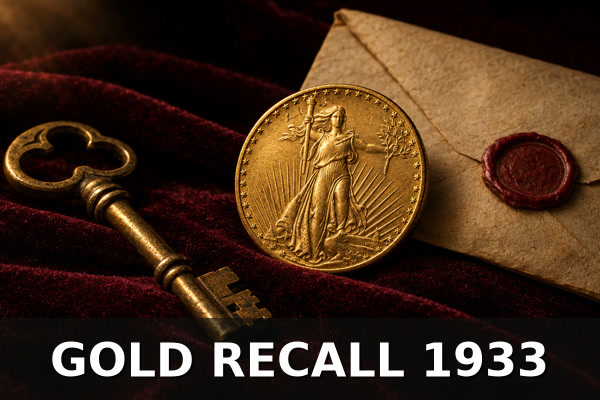
On April 5, 1933, President Franklin D. Roosevelt signed Executive Order 6102. It told Americans to turn in their gold coins, gold bullion, and gold certificates by May 1. Ninety-three years later, gold is near about $4,153 an ounce on our shop banner this Sunday, and an old $20 gold piece is worth roughly 200 times its face value in metal alone. The story behind that gap is one of the most useful history lessons a Tualatin or Portland-area gold buyer can know. It explains why pre-1933 U.S. gold exists, why collector coins are treated differently, and why paperwork still matters.
Local Coin Company is closed today, so consider this Sunday reading. Educational only, not investment or legal advice.
What the order actually said
The text of Executive Order 6102 is short and blunt. Anyone holding gold coin, gold bullion, or gold certificates had to deliver it to a Federal Reserve Bank or a member bank on or before May 1, 1933. In return, the bank paid out "an equivalent amount" of other U.S. coin or currency.
There were exceptions, and they are the part most retellings skip:
- Up to $100 in gold coin and gold certificates per person.
- Gold coins "having a recognized special value to collectors of rare and unusual coins."
- Gold needed for legitimate use in industry, a profession, or the arts, such as jewelers and dentists.
Willful violations carried a fine of up to $10,000, up to ten years in prison, or both. That collector exception is worth remembering. It is a big reason so many pre-1933 U.S. gold coins still exist to be bought and sold today.
Why Washington wanted the gold
According to the Federal Reserve's own history essays, the dollar was then tied to gold at a fixed $20.67 per ounce, and the Fed had to hold gold behind the currency it issued. In the banking panic of early 1933, gold drained out of the system as Americans traded deposits and paper money for metal and foreign investors worried about a devaluation. By March, the Federal Reserve Bank of New York could no longer meet its gold commitments, and Roosevelt declared a national banking holiday.
The Emergency Banking Act of March 1933 gave the government power to demand that gold be surrendered. The April order used that power. On April 20 a proclamation formally suspended the gold standard, and on June 5 Congress cancelled the "gold clauses" in contracts that promised payment in gold.
Here is a detail that makes the numbers click. A $20 gold piece holds 0.9675 troy ounce of pure gold. At $20.67 an ounce, that works out to almost exactly $20. Face value and metal value were designed to match.
The $35 reset
Then the match broke on purpose. Roosevelt signed the Gold Reserve Act on January 30, 1934. It moved ownership of the nation's monetary gold to the U.S. Treasury, and the next day the official price was set at $35 an ounce. The Federal Reserve notes that this cut the dollar's gold value to 59 percent of its old level. Put another way, people who handed in gold at $20.67 watched the official price rise about 69 percent within a year.
For about the next 40 years, Americans could not freely buy and sell gold bullion. Collector coins, jewelry, and licensed industrial uses were the main carve-outs.
1974: gold comes home
President Gerald Ford signed Public Law 93-373 on August 14, 1974. It said no law, rule, or order could be read to stop anyone from "purchasing, holding, selling, or otherwise dealing with gold." It took effect on December 31, 1974. Treasury guidance afterward noted that the 1933 gold-clause law still applied to contracts, but private ownership itself was legal again.
The modern bullion coin came next. The Gold Bullion Coin Act of 1985 created the American Gold Eagle in four sizes, with the one-ounce coin containing one troy ounce of fine gold, and sales could begin October 1, 1986. When it launched, contemporary reporting called it the first U.S. gold coin minted for public purchase since 1933. The U.S. Mint says the Eagle's obverse is inspired by Augustus Saint-Gaudens' $20 "Double Eagle," the same Lady Liberty design struck from 1907 to 1933.
The coin that slipped through
The 1933 Saint-Gaudens double eagle was struck but never released into circulation, and nearly all were melted. Exactly one example is legal for a private person to own, after a settlement with the U.S. government led to its 2002 auction for about $7.59 million. On June 8, 2021, Sotheby's sold that same coin in New York for a record $18.9 million.
The lesson for ordinary buyers is not about eight-figure rarities. It is that the line between "bullion" and "collector coin," and a clean ownership history, can matter enormously.
What this history means at the counter today
Pre-1933 gold is still real gold. Liberty Head and Saint-Gaudens $20 pieces are 90 percent gold and each holds about 0.9675 troy ounce of pure gold. At this Sunday's banner, that metal alone is worth roughly $4,000 before any premium. Common-date coins are generally priced from their gold content plus a premium, while scarce dates and high grades can bring collector money. That is the same line the 1933 order drew.
Modern coins are simpler to price. A one-ounce Gold Eagle contains a full troy ounce of gold. Our gold page lists Eagles, Maples, Buffalos, Krugerrands, Philharmonics, Kangaroos, and bars, plus British Sovereigns and European 20 Francs (call for pricing). Recent asking prices for a one-ounce Eagle have been near about $4,337. Offers move with the market, so confirm live numbers in the shop.
Be careful with fear-based pitches. No one can promise what future lawmakers will do, and we will not pretend to. But the 1933 order rested on emergency banking powers, Congress ended the ownership restrictions in 1974, and the Federal Reserve's own history describes today's gold market as held in the hands of individuals and firms. If a sales pitch uses a "new recall" to justify a much higher premium, compare the actual gold content and the buyback spread first.
Keep records. Receipts, a simple inventory, and notes about where inherited coins came from make it easier to sell later, to settle an estate, and to tell a common coin from a collectible one.
Have Grandpa's gold coins? Bring the story in
If your family has $20 or $10 gold pieces that someone kept through the 1930s or bought after 1974, they are worth a careful look. Local Coin Company buys and sells gold, including coin collections. We can help you sort common-date coins from pieces that deserve a closer look as collectibles, and give you a buy price.
We are closed Sundays. Visit Local Coin Company at 19354 SW Boones Ferry Rd., Tualatin, OR 97062, Monday through Friday 8 to 4 or Saturday 8 to 3. Appointments have priority, so call 503-855-5255 to schedule. Check our gold page before you come, and see our guide to numismatic vs. bullion coins for more on telling them apart.
RETURN <<